
Our Parts Distribution Centers
Ontario, CA
Arlington, TX
Schaumburg, IL
Crown Point, IN
Atlanta, GA
Franklinville, NC
1 YEAR WARRANTY ALL PARTS
Developed & Tested in the US
Meets or Exceeds OE Specs
Less Than 1% Failure Rate
100% New - No Core Program
SALE
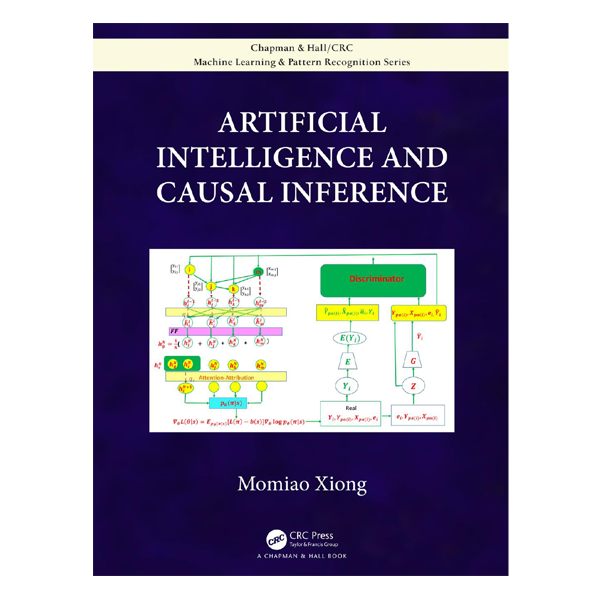
Artificial Intelligence and Causal Inference 1st By Momiao Xiong
$ 5.10
Author : Katie Nygard
Book Description Artificial Intelligence and Causal Inference address the recent development of relationships between artificial intelligence (AI) and causal inference. Despite significant progress in AI, a great challenge in AI development we are still facing is to understand mechanism underlying intelligence, including reasoning, planning and imagination. Understanding, transfer and generalization are major principles that give rise intelligence. One of a key component for understanding is causal inference. Causal inference includes intervention, domain shift learning, temporal structure and counterfactual thinking as major concepts to understand causation and reasoning. Unfortunately, these essential components of the causality are often overlooked by machine learning, which leads to some failure of the deep learning. AI and causal inference involve (1) using AI techniques as major tools for causal analysis and (2) applying the causal concepts and causal analysis methods to solving AI problems. The purpose of this book is to fill the gap between the AI and modern causal analysis for further facilitating the AI revolution. This book is ideal for graduate students and researchers in AI, data science, causal inference, statistics, genomics, bioinformatics and precision medicine. Key Features: Cover three types of neural networks, formulate deep learning as an optimal control problem and use Pontryagin’s Maximum Principle for network training. Deep learning for nonlinear mediation and instrumental variable causal analysis. Construction of causal networks is formulated as a continuous optimization problem. Transformer and attention are used to encode-decode graphics. RL is used to infer large causal networks. Use VAE, GAN, neural differential equations, recurrent neural network (RNN) and RL to estimate counterfactual outcomes. AI-based methods for estimation of individualized treatment effect in the presence of network interference.